Why is my concrete driveway cracking?
If your concrete driveway is cracking, it may be perfectly normal, or it may be a warning. Concrete shrinks and moves, so nearly every slab will crack somewhere. The pattern usually tells you the cause, and the cause tells you if you should seal it, fix it or replace it.
Updated
| What you see | Likely cause | What to do |
|---|---|---|
| Thin line across a panel | Shrinkage | Seal it if water gets in |
| Crack at a slab corner | Weak edge support, or a missing joint | Seal it and watch it |
| One side higher | Settling, roots or frost | Lift or replace that panel |
| Web of fine cracks | Finishing or fast drying | Seal the surface |
| Flaking top layer | Salt and freeze-thaw | Seal or resurface |
| Many cracks, broken pieces | Failed base or thin slab | Replace |
Shrinkage cracks
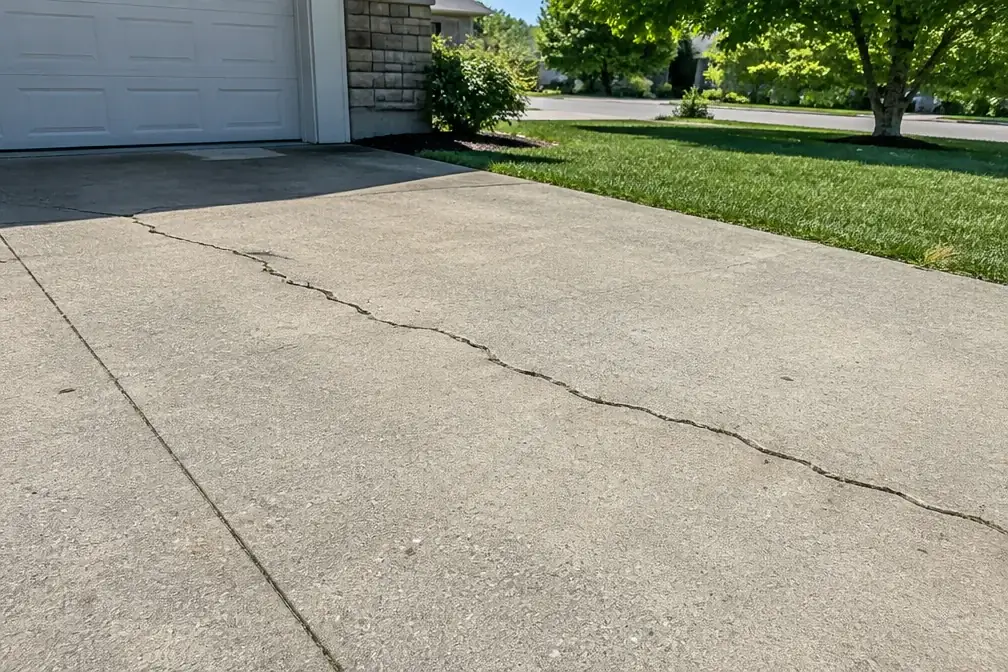
As concrete cures, it loses water and shrinks by about 1/16 inch for every 10 feet. The ground under it holds it back, and since concrete is weak in tension, it cracks. That's why contractors cut joints. A saw cut makes a weak line, so that the crack forms at the bottom of that line where you can't see it.
Cracks away from the joints usually mean they were too far apart, too shallow or cut too late. Those cracks look bad, but they're rarely dangerous. They tend to stop growing within the first year or two. Seal them to keep the water out, and don't let anybody tell you that one thin line means that you need a new driveway.
Freeze-thaw and salt damage
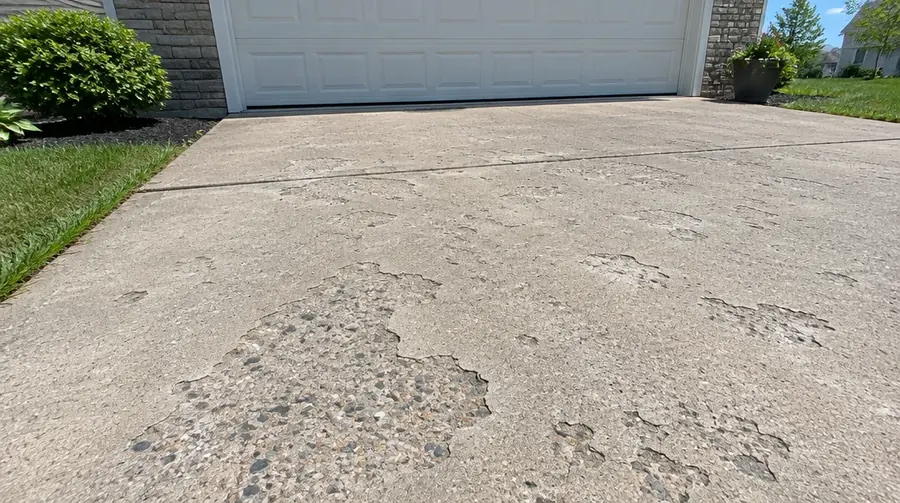
Pittsburgh's winters are hard on concrete, because they swing above and below freezing again and again. Water soaks into the slab, freezes, expands by about 9 percent and pushes outward. Over the years, this breaks down concrete without enough air in it. Salt makes it worse. It holds in moisture and adds more freeze-thaw cycles.
That's usually what scaling is, where the top flakes off in patches and the stone shows through. You'll often see it first near the garage, where cars drip road salt, or along the edge where snow gets piled. Sealing helps stop it, and a bonded overlay can fix the surface if the slab is sound.
Settling and a failed base
Cracks with a step in them, where one side is higher, tell a different story. Something under the slab has moved. On local lots, the usual reasons are water washing out the stone, loose fill next to the foundation, old sewer or gas trenches and soft clay. Frost can lift a slab in winter and drop it unevenly in spring, particularly when there's no drainage under it.
These cracks won't stop on their own, because the cause is still there. Measure the step with a ruler, then check it again in a few months. If it's growing, you need to find the water. Trip hazards of more than about 1/2 inch deserve attention too. Our page on sunken driveway repair covers the options.
Tree roots
The older streets of Pittsburgh have big trees, and big roots lift slabs. You'll usually see a raised hump or a crack running in line with the root. Silver maples and other shallow-rooted trees are the usual suspects. Don't cut big roots without getting advice, as that can kill or destabilize the tree. A better fix is sometimes a new, thicker slab with a root barrier, or a change to the driveway's path. If a stump was buried under the slab, it'll rot and leave a void behind.
Bad joints and thin slabs
Plenty of early cracking goes back to how a driveway was built. These are the common mistakes.
- Slabs thinner than 4 inches, or thin in spots
- Too much water added at the truck
- Joints spaced too far apart or cut too late
- Long, narrow panels
- No isolation joint at the garage or steps
- Curing skipped on a hot, windy day
- Steel lying on the stone, or too near the surface
How to check your cracks at home
You don't need any tools beyond a ruler and a phone. Take a photo of each crack with the ruler in the shot, and note the date. Check again in spring and fall, since cracks open in cold weather and close up in the heat. If a crack is wider in the same season a year later, it's still moving.
Next, look at what's around the crack. Does a downspout empty nearby? Is the soil washed out along the edge of the slab? Does a car always park over the same spot? Pour a bucket of water on the driveway and watch where it goes. If the water runs into the crack or settles beside it, you've probably found your cause.
A coin is a useful gauge. If a dime fits into a crack, it's wide enough to seal before winter. If you can get a nickel in, or if one side is higher than the other, have someone take a look.
How to stop new cracks
You can't stop concrete from cracking altogether, but you can slow the damage on an older slab with a few simple steps.
- Run downspouts to the lawn, well away from the slab
- Fill washed-out soil along the edges, so the slab stays supported
- Keep joints and cracks sealed, and check them each fall
- Seal the surface every few years to keep out salt and water
- Keep heavy trucks and dumpsters off the thin outer edges
- Use sand instead of rock salt whenever you can
Fix it or replace it?
Thin cracks in a level slab are a job for sealant. A few bad panels can be cut out. But when cracking runs across most of the driveway, or the slab is broken into loose pieces, there's no patch that'll hold, and you're paying to delay the inevitable. A good rule of thumb is that if more than a quarter of the slab needs work, compare the cost of a new one.
Try the check on our home page for a quick opinion, or see driveway crack repair for how we seal cracks. If you need a real answer, we'll come and look at it as part of a free estimate, and we'll tell you if all you need is a tube of sealant.
Common questions
How long does concrete last before breaking down?
Decades if it's well made. Salt, poor drainage and a low-air mix can bring this down to 10 years or less.
How long does concrete last underground?
It can last many decades if it's kept away from aggressive water and repeated freezing.
How long does concrete take to dry after rain?
A slab surface dries in hours, but the concrete underneath can stay damp for days.
More driveway services
- concrete driveway installation
- concrete driveway replacement
- concrete driveway repair
- concrete driveway resurfacing
- stamped concrete driveway
- exposed aggregate concrete driveway
- driveway trench drain
- driveway drainage
- driveway apron
- concrete driveway sealing
- driveway crack repair
- sunken driveway repair
- driveway extension